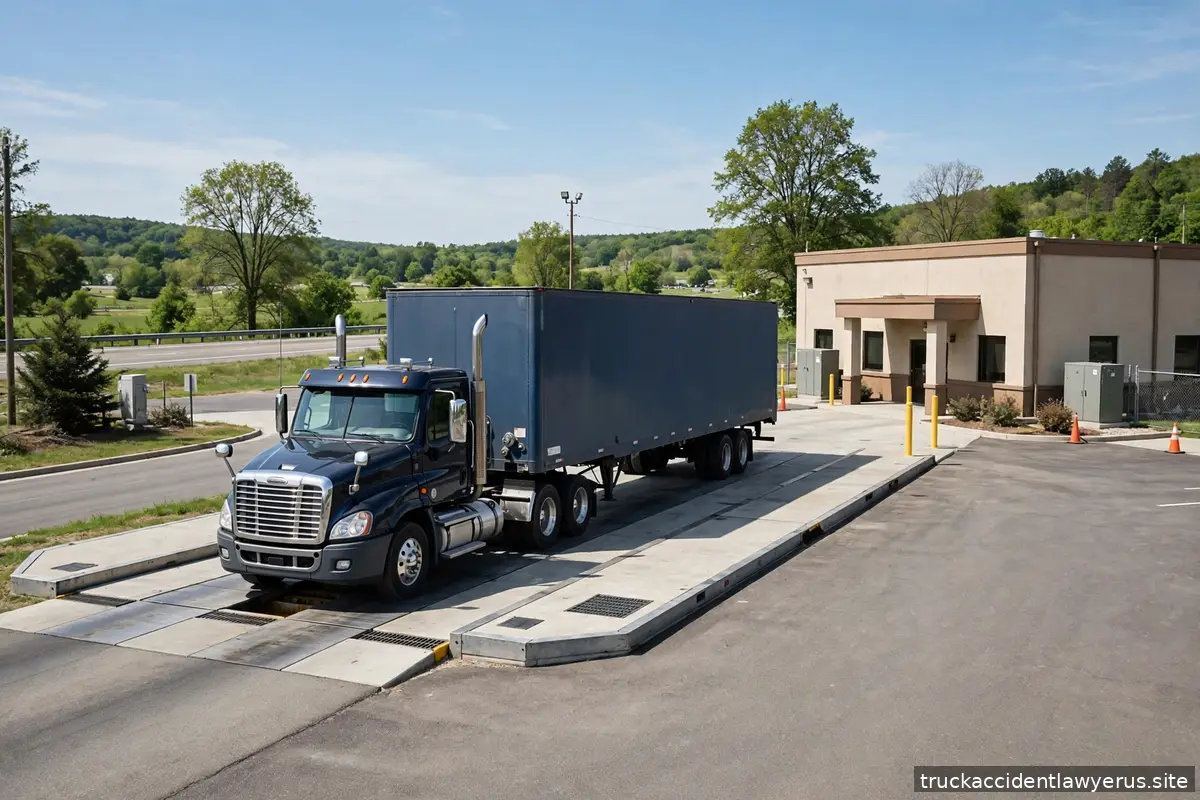
Every highway bridge has a weight rating, every truck tire has a load limit, and every braking system is engineered for a maximum mass. Truck weight limits exist because physics is non-negotiable: a truck carrying more weight than its systems were designed for cannot stop, steer, or stay upright the way it should. Overloading is not a paperwork violation — it is a crash cause.
This guide explains truck weight limits in plain English: the federal standards, why they exist, how overloading causes specific crash types, and how weight violations get discovered and used in accident claims. General information, not legal advice.
The Federal Weight Limits
On the Interstate Highway System, federal law sets the baseline maximums: 80,000 pounds gross vehicle weight (the truck, trailer, cargo, and fuel combined), 20,000 pounds on a single axle, and 34,000 pounds on a tandem axle group. These are ceilings, not targets — many trucks operate well below them. States set their own limits for non-Interstate roads, sometimes higher with special permits, sometimes lower on specific bridges and roads.
The limits work together with the bridge formula, a federal calculation that sets maximum weights based on the number of axles and the distance between them. The formula’s purpose is to prevent concentrated loads from overstressing bridges: spreading weight across more axles and longer spans protects infrastructure. A truck can be under 80,000 pounds total and still violate the bridge formula if its axles are too close together for the load.
Why Weight Limits Exist: The Physics
Weight affects every dynamic system on a truck. Braking: kinetic energy grows with mass, so a heavier truck needs more distance to stop — and generates more heat in its brakes doing so, which can cause brake fade (loss of braking power from overheated components) on long downgrades. Steering and stability: excess weight raises the center of gravity, especially with top-heavy or poorly distributed loads, making rollovers dramatically more likely in curves, lane changes, or sudden maneuvers.
Tires: every tire has a maximum load rating; exceeding it generates excess heat and stress, increasing blowout risk — and a steer-tire blowout at highway speed can send a truck across lanes before the driver can react. Structural components: suspensions, couplings, and frames stressed beyond design limits can fail catastrophically. None of these systems has a safety margin for illegal overweight operation; the margins were consumed by the excess weight.

How Overloading Happens
Overloading is rarely an accident in the innocent sense — it is usually an economic decision. More cargo per trip means more revenue per trip, and the temptation to squeeze in extra pallets or skip the weigh station is a direct function of financial pressure. Common patterns include shippers understating cargo weight on shipping documents, loaders exceeding the planned weight, drivers skipping required weigh-station stops, and carriers tacitly encouraging “just this once” overloads that become routine.
Weight distribution matters as much as total weight. A legally-weighted truck with cargo stacked too high or loaded entirely to one side can be more dangerous than a slightly overweight but well-balanced one. Federal cargo-securement rules address both weight and distribution, requiring tiedowns adequate for the load and inspections during the trip. Improper securement lets cargo shift in transit, changing the truck’s handling characteristics mid-trip — sometimes mid-maneuver.
Crash Types Linked to Overloading
Rollovers
The classic overweight crash. A top-heavy or overloaded trailer entering a curve or making a sudden lane change rolls when centrifugal force overcomes the trailer’s stability threshold — a threshold that drops as weight and center-of-gravity height increase. Rollover crashes are among the deadliest truck crash types because the trailer can crush adjacent vehicles and spill cargo across lanes.
Brake failure on downgrades
Long, steep downgrades are where overweight trucks die. Brakes convert the truck’s kinetic energy into heat; overweight trucks generate more heat than the brake system can dissipate, leading to fade and then total loss of braking. Runaway-truck ramps exist precisely for this scenario. Investigators in downgrade crashes always check weight — an overweight truck with faded brakes tells a clear story.
Tire blowouts
Overloaded tires run hot and fail suddenly. A drive-tire blowout destabilizes the truck; a steer-tire blowout can cause immediate loss of steering control. Post-crash tire examination — looking for signs of overloading like excessive heat damage versus road-hazard punctures — is standard in serious investigations.
Bridge and infrastructure strikes
Overweight trucks damage bridges cumulatively and can cause acute failures on weight-restricted structures. Height is the more common infrastructure issue (bridge strikes), but weight violations compound the damage and the liability when they occur together.

How Weight Is Enforced
Weigh stations on major highways are the primary enforcement mechanism: trucks are directed in, weighed on scales, and inspected. Bypass systems (like PrePass) let carriers with good safety records skip some stations, which concentrates enforcement on higher-risk operators. Portable scales and roadside inspections supplement fixed stations. Penalties for overweight operation include fines that scale with the excess, orders to offload cargo before proceeding, and out-of-service orders for serious violations.
Enforcement is imperfect — not every truck passes a scale on every trip, and determined violators learn the gaps. But the enforcement record that does exist becomes evidence: a carrier with repeated overweight citations has a documented pattern that speaks to its safety culture, and a clean record does not prove any particular trip was legal.
How Weight Violations Surface in Crash Claims
After a serious crash, weight becomes a forensic question. Investigators use several methods: weighing the wreckage — cargo and vehicle components can be weighed after the crash, though spilled or burned cargo complicates this. Shipping documents — the bill of lading states the cargo weight; comparing it to the truck’s empty weight reveals the total. Scale records — weigh-station and CAT-scale receipts along the route show what the truck weighed at specific points. Shipper records — loading dock scales and inventory records independently document what went onto the trailer.
Discrepancies between these sources are revealing: a bill of lading showing legal weight alongside scale receipts showing overweight suggests document falsification — itself evidence of a carrier cutting corners. Like hours-of-service data, weight evidence is documentary and objective, making it powerful in both negotiation and trial. If overloading is suspected, preserving shipping documents and scale records early is as important as preserving electronic log data.
The Shipper’s Role and Liability
Weight violations often implicate the shipper, not just the carrier. Shippers who misdeclare cargo weight, pressure drivers to accept overweight loads, or load trailers beyond safe distribution share responsibility for the resulting danger. Federal regulations place cargo-securement duties on both drivers and shippers, and the shipper’s loading decisions are documented in records the shipper controls.
This is one reason thorough truck investigations identify the shipper early and preserve loading-dock records: the overweight story frequently starts at the loading dock, not on the highway. A driver who objected to an overweight load — and was overruled — is a sympathetic witness whose account can redirect liability toward the parties that actually made the decision. Our overview of who can be liable in a truck accident covers how shipper liability fits the bigger picture.
Related guides: How Truck Accident Settlements Are Calculated, How to Document a Truck Accident Scene for Your Claim.
Frequently Asked Questions
How would I know if the truck that hit me was overweight?
You probably would not know at the scene — overweight trucks look like normal trucks. Clues include cargo visibly straining the trailer, the truck struggling on grades, or brake smoke on downgrades. The definitive answer comes from post-crash investigation: shipping documents, scale records, and weighing the wreckage.
Can trucks legally exceed 80,000 pounds?
Yes, with special overweight permits for non-divisible loads (like construction equipment) that cannot be broken into smaller shipments. Permitted overweight loads follow designated routes, often with escort vehicles and travel-time restrictions. A permit does not excuse unsafe operation — it comes with its own safety conditions.
Do weight limits apply to my car or SUV?
Not the federal truck limits — those apply to commercial vehicles on the Interstate system. Passenger vehicles have manufacturer gross vehicle weight ratings (on the door sticker), and exceeding them is unsafe, but the federal enforcement regime targets commercial trucks.
What if the cargo was cleaned up before anyone weighed it?
Secondary evidence fills the gap: the bill of lading, shipper loading records, scale receipts from earlier in the trip, and the driver’s own statements about the load. This is why identifying the shipper and requesting loading records early matters — the paper trail often survives even when the physical cargo is gone.
Weigh Station Bypass Systems: The Two-Tier Reality
Programs like PrePass allow carriers with strong safety records to bypass weigh stations electronically — the truck’s transponder gets a green light and it rolls past. The logic is sound: concentrate limited enforcement resources on higher-risk operators rather than stopping every compliant truck. But it creates a two-tier system where the most-scrutinized carriers are the ones already trying to comply, while determined violators study bypass patterns and route around fixed stations.
Enforcement agencies counter with mobile patrols, portable scales deployed unpredictably, and data analysis flagging carriers whose bypass rates or routes look anomalous. Some states have invested in weigh-in-motion sensors embedded in highways that screen trucks at speed and flag only the suspicious ones for pull-in — technology that makes evasion harder without stopping compliant traffic. For crash investigations, bypass records themselves become evidence: a carrier whose trucks systematically avoided weigh stations on the crash route invites obvious questions about what they were avoiding.
The practical takeaway for claimants is that weight enforcement, like hours enforcement, generates records — scale receipts, bypass logs, citations — and those records are discoverable. An overweight defense that relies on “we didn’t know” collapses quickly against a paper trail of avoided scales and prior overweight citations.
This guide is for general information only and is not legal advice. Weight regulations have state-specific variations — consult a licensed attorney about your situation.