In a car crash, liability usually comes down to one question: which driver was at fault? In a truck accident, the answer is often a list. The driver, the trucking company, the freight broker, the shipper who loaded the trailer, the company that maintained the truck, and even the manufacturer of a failed part can each bear a share of responsibility. Understanding who can be liable — and why it matters — is foundational to any truck accident claim.
This guide maps the potential parties in plain English: what each one does, how their negligence can cause a crash, and why identifying all of them early changes the value and strategy of a claim. General information only, not legal advice.
Why Truck Accidents Have Multiple Liable Parties
A commercial truck is not just a big vehicle — it is a business operation on wheels. The person driving it may not own it. The company whose name is on the door may not have loaded it. The brakes may have been serviced by a third-party shop, the tires made by a manufacturer, and the trip arranged by a broker who never touched the truck. Each participant has legal duties, and a breach of any of those duties can contribute to a crash.
This matters for a practical reason: each liable party typically brings their own insurance to the table. A claim against only the driver might be limited by a modest personal policy; a claim that properly includes the carrier, the broker, and the maintenance company can access the commercial policies that actually cover serious injuries. Missing a liable party does not just simplify the case — it can leave money unrecoverable.
The Truck Driver
The driver is the most obvious potentially liable party. Driver negligence takes familiar forms — speeding, distracted driving, following too closely, improper lane changes, driving while fatigued or impaired — but the consequences are magnified by the vehicle’s size. A moment’s inattention in a passenger car causes a fender-bender; in an 80,000-pound truck it causes a catastrophe.
Driver-specific duties go beyond ordinary careful driving. Commercial drivers must hold a valid commercial driver’s license (CDL) with proper endorsements, maintain a current medical certification, comply with hours-of-service limits, conduct pre-trip inspections, and secure cargo properly. Violations of these duties — driving beyond legal hours, skipping inspections, operating without proper endorsements — are powerful evidence of negligence. Our guide to common causes of truck driver negligence details the patterns investigators look for.

The Motor Carrier (Trucking Company)
The motor carrier — the company operating the truck — is frequently the most important defendant in a truck accident case. Carriers can be liable in two ways. First, through vicarious liability: when an employee driver causes a crash within the scope of employment, the employer is generally responsible for the employee’s negligence. This doctrine alone makes the carrier liable in most crashes involving company drivers.
Second, through the carrier’s own negligence: hiring unqualified drivers, failing to check driving records, pressuring drivers to violate hours-of-service rules through unrealistic schedules, neglecting vehicle maintenance, or failing to supervise. These direct-negligence claims can be even more significant than vicarious liability because they implicate company policies and profits — the systemic choices that put a dangerous truck on the road. See our explainer on vicarious liability for how the employment relationship is analyzed.
The Freight Broker
Freight brokers arrange transportation between shippers and carriers without owning trucks themselves. When a broker hires a carrier with a terrible safety record — multiple prior crashes, out-of-service violations, lapsed insurance — and that carrier’s truck then causes a crash, the broker’s negligent selection can become a basis for liability. The argument: the broker had a duty to hire reasonably safe carriers and breached it by choosing a dangerous one to save money.
Broker liability is actively litigated and the law varies by jurisdiction — federal law preempts some state-law claims against brokers while leaving others intact, and courts disagree about where the line falls. But the practical point stands: identifying the broker (from shipping documents or the bill of lading) preserves a potential avenue of recovery and another insurance policy. Brokers often carry contingent liability coverage precisely for these situations.
The Shipper and Loader
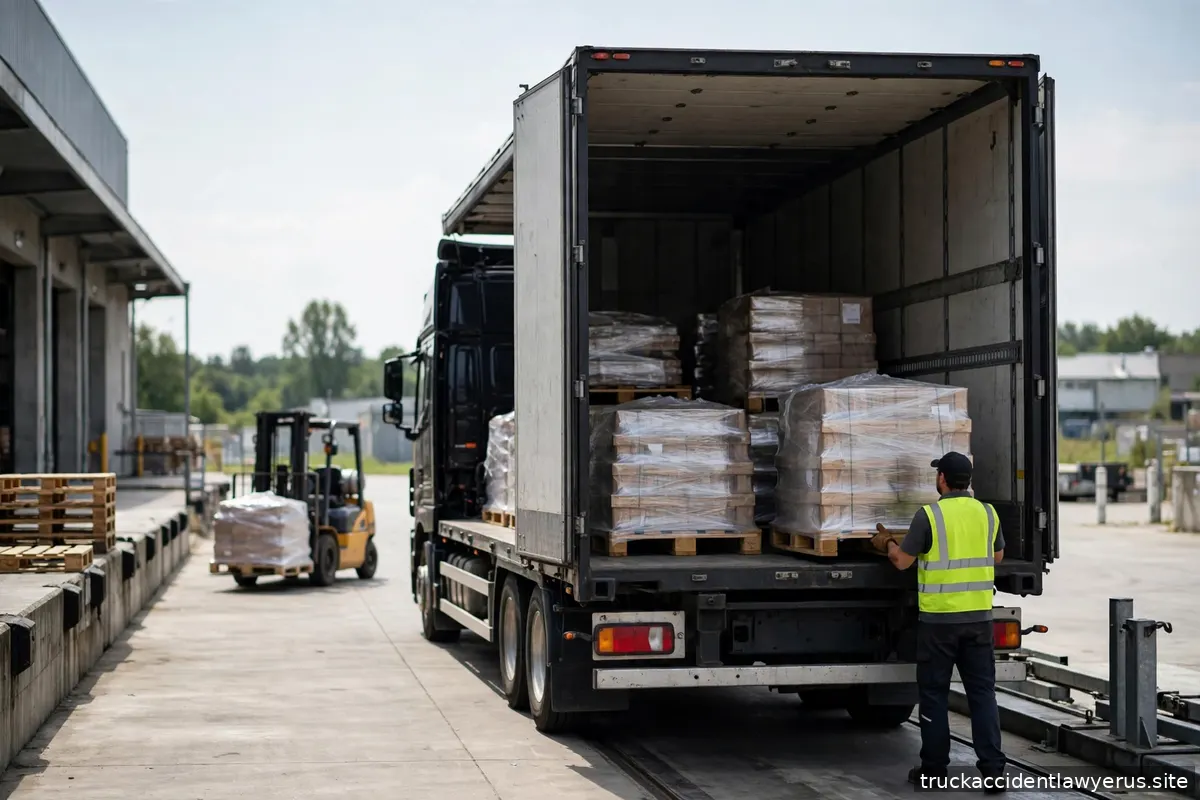
Whoever loaded the trailer bears responsibility for doing it safely. Improperly loaded cargo — overweight, unbalanced, or unsecured — can cause rollovers, jackknifes, and lost loads. Federal cargo-securement rules set detailed standards for tiedowns, weight distribution, and inspection, and violations are discoverable through loading records and the physical evidence of how the cargo shifted.
Shippers can also be liable for hiring practices similar to brokers, and for misrepresenting the nature of freight — failing to disclose hazardous materials, for example, which changes everything about how the load must be handled. If cargo played any role in the crash, the loading story deserves its own investigation.
The Maintenance Company
Many carriers outsource maintenance to third-party shops. If brake failure, a tire blowout, or a steering defect caused the crash, the shop that last serviced the truck — or that was supposed to — may share liability. Maintenance records show what was inspected, what was found, and what was deferred; gaps in those records speak volumes.
Maintenance liability often overlaps with the carrier’s own duties, since federal regulations require carriers to systematically inspect and maintain their vehicles regardless of who turns the wrenches. A carrier cannot outsource its safety obligations by hiring a cheap shop and looking away — though some try, which is exactly what discovery is designed to uncover.
The Parts or Truck Manufacturer
Sometimes the crash was not anyone’s driving or maintenance failure but a defective product: brakes that failed despite proper maintenance, a tire that blew out without warning, a coupling device that released. Product-liability claims against manufacturers follow different rules than negligence claims — in many states, a manufacturer can be liable for a defective product regardless of how careful everyone else was.
These claims require preserving the failed part itself, which means acting fast before the truck is repaired or salvaged. If a mechanical failure is suspected, the vehicle and its components become the most important evidence in the case.
The Government Entity (Road Cases)
Occasionally the road itself contributes: missing guardrails, unmarked construction zones, malfunctioning signals, or dangerous road design. Claims against government entities follow special rules — shorter notice deadlines (sometimes as short as 30 to 180 days), damage caps, and immunity doctrines that vary widely by state. If road conditions played a role, these deadlines make early legal advice especially important.
How Shared Liability Works in Practice
When multiple parties share fault, states apportion responsibility by percentage — the jury or negotiators assign each party a share, and each pays accordingly. In most states, you can collect from each liable party for their share; some states also allow collecting the full amount from any sufficiently-at-fault party (joint and several liability), with the defendants sorting out reimbursement among themselves. The rules are state-specific and genuinely complicated, which is one reason truck cases with multiple defendants almost always involve lawyers on all sides.
For you as a claimant, the strategy is straightforward even if the law is complex: identify every potentially liable party early, preserve evidence against each one, and do not let any of them exit the picture quietly. Insurers for each party will try to shift blame to the others — modern truck data increasingly settles these finger-pointing disputes with objective records. Let the evidence, not the insurers’ preferences, determine who pays.
Related guides: 2026: New Safety Technology Rules on the Horizon for Trucks, How Long Does a Truck Accident Settlement Take?, 2026: How Dashcam Footage Is Changing What Happens Right After a Truck Crash.
Frequently Asked Questions
Can I just sue the driver and skip the companies?
You can, but it is usually a mistake. Individual drivers rarely have assets or insurance sufficient for serious injuries, while the carrier’s commercial policy is designed for exactly these claims. Naming the driver alone leaves the deepest pockets — and often the most culpable systemic negligence — out of the case.
What if the driver was an independent contractor?
Carriers often classify drivers as contractors to distance themselves from liability, but courts look past labels to the reality of control: who set schedules, who owned the truck, who directed the work. Many “contractor” drivers are legally employees for liability purposes. This is heavily fact-dependent — get advice rather than accepting the carrier’s characterization.
How do I find all these parties after a crash?
Start with the police report, the truck’s DOT number, and any shipping documents or bills of lading. The DOT number identifies the carrier; shipping paperwork identifies brokers and shippers; maintenance records (obtained through formal process) identify shops. Each answer tends to reveal the next question — which is why early investigation matters.
Do claims against multiple parties have different deadlines?
The general statute of limitations usually applies to all private parties equally, but government-entity claims have much shorter notice deadlines, and some insurance policies have their own notice requirements. Calendar the shortest deadline that could apply and work backward from there.
How the Full Party Map Gets Investigated
Identifying every liable party is investigative work, and it follows a paper trail. The police report and the truck’s DOT number identify the driver and carrier. The bill of lading — the shipping document for the load — identifies the shipper and often the broker who arranged the transport. Dispatch records show who controlled the driver’s movements. Maintenance logs reveal who serviced the truck and when. Each document answers one question and raises the next, which is why investigators request records broadly and early.
Timing matters because each party’s records have their own retention schedules, and parties with exposure have incentive to let inconvenient documents disappear through “routine” destruction. Formal preservation letters to every identified party — not just the carrier — freeze the record before that happens. If you are pursuing a claim involving multiple parties, make sure whoever is handling it casts the preservation net wide: a broker’s carrier-selection file or a shipper’s loading records can be as decisive as the truck’s own data, and they are just as perishable.
This guide is for general information only and is not legal advice. Liability rules vary significantly by state — consult a licensed attorney about your specific situation.