Among all the regulations governing commercial trucking, none matters more in accident claims than the hours-of-service (HOS) rules: the federal limits on how long truck drivers can drive and how much rest they must take. These rules exist for one reason — tired truck drivers kill people — and violations of them are among the most powerful evidence in truck accident cases.
This guide explains the HOS rules in plain English: the actual limits, the required breaks, how electronic logging devices enforce them, the key exceptions, and why these rules show up in nearly every serious truck accident investigation. General information, not legal advice.
Why These Rules Exist
Driving a loaded tractor-trailer demands sustained attention for hours at a time, often overnight, on monotonous highways — conditions practically designed to produce fatigue. Before federal limits, drivers routinely ran 16- or 20-hour days under dispatch pressure, and fatigue-related crashes were endemic. The hours-of-service rules set legal boundaries on driving time specifically to prevent exhaustion-induced crashes.
The rules apply to drivers of commercial motor vehicles in interstate commerce — generally vehicles over 10,001 pounds, vehicles hauling hazardous materials, or vehicles designed to carry enough passengers to trigger the thresholds. Most long-haul truck drivers you share the highway with are covered. States have their own versions for intrastate drivers, often mirroring the federal rules.
The Core Limits: 11, 14, and 70
The property-carrying HOS rules (which cover freight trucks) revolve around three numbers worth memorizing. 11 hours: after coming on duty, a driver may drive a maximum of 11 hours before needing 10 consecutive hours off duty. 14 hours: a driver may not drive after the 14th consecutive hour on duty following 10 hours off — even if only 8 of those 14 hours were spent driving. The 14-hour clock runs continuously once the driver starts work; it cannot be paused with a nap or a long lunch. 70 hours: a driver may not drive after accumulating 70 on-duty hours in 8 consecutive days (or 60 hours in 7 days for carriers that do not operate every day).
A driver who hits any of these limits must stop driving until they get the required rest — 10 consecutive hours off duty resets the 11- and 14-hour clocks, and a 34-hour restart resets the 70-hour clock. The system is designed so that driving time is always bracketed by genuine rest.

The 30-Minute Rest Break Rule
In addition to the big limits, drivers must take a 30-minute break after 8 cumulative hours of driving time. The break can be off-duty time, sleeper-berth time, or on-duty non-driving time (like fueling or loading) — but it must be a genuine 30 consecutive minutes away from driving. This rule targets the mid-shift fatigue dip, when attention fades even in drivers who started the day rested.
In investigations, the break rule is checked against ELD data: did the driver actually log 30 consecutive non-driving minutes within the first 8 hours of driving? Missing or fragmented breaks are common violations and suggest a driver pushing through fatigue.
Sleeper Berth Rules
Long-haul drivers often sleep in the truck’s sleeper berth, and the rules allow splitting the required 10 hours off duty into two periods — typically 7+3 or 8+2 — provided one period is at least 7 consecutive hours in the berth and the two periods total at least 10 hours. Split-sleeper rules are among the most complex and most violated provisions, because they require careful calculation of how each segment affects the 14-hour driving window.
For claim purposes, sleeper-berth splits matter when a driver claims to have rested: was the “rest” actually qualifying rest under the rules, or just time logged creatively? ELD data combined with location records can reveal whether a driver genuinely spent 7 hours in a sleeper berth or was active during logged rest time.
Electronic Logging Devices: The End of Paper Logs
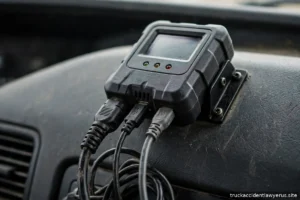
Since the ELD mandate took full effect, most covered drivers must use electronic logging devices that automatically record driving time from the truck’s engine data. ELDs were required precisely because paper logbooks were routinely falsified — drivers kept two sets of books, one for inspectors and one reflecting reality. Automatic recording made the most common falsification much harder.
ELDs do not eliminate cheating — they change its form. Common workarounds include driving under another driver’s login, logging driving time as on-duty non-driving, or exploiting the personal-conveyance exception. Investigators know these patterns and cross-check ELD data against fuel receipts, toll records, GPS tracks, and dispatch messages. Inconsistencies between the ELD story and the paper trail are red flags that get pursued aggressively. Our guide to truck black boxes and ELDs goes deeper on what these devices record.

Key Exceptions (and How They Get Abused)
Several exceptions modify the standard rules. The short-haul exception exempts drivers operating within a 150 air-mile radius who start and end at the same location within 14 hours — common for local delivery drivers. The adverse driving conditions exception extends driving time by up to 2 hours when unexpected bad weather or road conditions slow the trip (it does not cover delays the driver knew about before dispatch). The personal conveyance provision allows limited personal use of the truck off-duty, such as driving to a nearby restaurant during rest time.
Each exception has defined boundaries, and each gets stretched. Personal conveyance claimed for a 200-mile repositioning trip is not personal conveyance. Adverse conditions invoked for routine traffic is not adverse conditions. When a carrier’s defense rests on an exception, the exception’s actual requirements deserve skeptical examination against the trip’s facts.
Why HOS Violations Matter So Much in Claims
Hours-of-service violations are uniquely powerful evidence for three reasons. First, they are objective: ELD data either shows compliance or it does not, unlike subjective debates about attentiveness. Second, they connect directly to causation: a driver who had been driving for 13 straight hours when the crash occurred was presumptively fatigued, and fatigue explains exactly the kind of crash that happened — drifting, delayed braking, no evasive action. Third, they can establish negligence as a matter of law in many states: violating a safety regulation designed to prevent this exact harm counts as negligence per se.
Beyond the driver’s violation, HOS evidence often implicates the carrier: dispatch records showing the driver was given a schedule no legal driver could meet, or a pattern of violations across the fleet suggesting the company tolerated or encouraged non-compliance. The driver’s logbook violation is the symptom; the carrier’s operations may be the disease. This is also why insurers fight hard over HOS evidence — they understand its power as well as claimants do.
What You Should Know After a Crash
You do not need to memorize HOS tables, but a few practical points help. If the crash happened late at night or in the early morning hours, fatigue is a natural line of inquiry — ask (through your lawyer) that ELD data and dispatch records be preserved immediately. If the driver mentions being “almost done with my shift” or “running behind,” note it — those remarks can indicate HOS pressure. And if the police report notes logbook issues or the officer requested a log inspection, that detail deserves follow-up.
The broader lesson: truck accident investigation is partly regulatory investigation. The rules create the paper trail — logs, inspections, certifications — and the paper trail either exonerates or implicates. Knowing the rules exist is what lets you ask for the trail before it disappears.
Related guides: 2026: Virtual Consultations Are Now the Norm: What to Expect, Should You Call the Police After a Truck Accident?.
Frequently Asked Questions
Do hours-of-service rules apply to regular drivers?
No — they apply to commercial motor vehicle drivers in covered operations. Ordinary passenger-car drivers follow no federal driving-time limits, though drowsy driving laws in some states can penalize anyone who drives while dangerously fatigued.
What about team drivers who take turns?
Team operations use the sleeper-berth provisions: while one driver drives, the other rests in the berth, and they swap. Each driver is still individually subject to the 11-hour driving limit and related rules for their own driving periods. Team driving does not exempt anyone from the limits — it just lets the truck keep moving.
Do all states follow the same rules?
Interstate drivers follow the federal rules everywhere. Intrastate drivers follow their state’s rules, which often mirror the federal ones but can differ in details like the short-haul radius. The applicable regime depends on whether the trip was interstate or intrastate commerce.
Have the rules changed recently?
The core 11/14/70 framework has been stable for years, though FMCSA periodically adjusts specific provisions (such as the 30-minute break flexibility and sleeper-berth split options). Regulatory details evolve — for current specifics, the FMCSA’s official site is the authoritative source.
How the System Gets Gamed — and Caught
Every enforcement system develops workarounds, and HOS is no exception. The classic ELD-era tricks include ghost drivers (logging driving time under a co-driver’s login), yard-move abuse (using the yard-move special driving category for what is actually road driving), personal-conveyance stretching (claiming hundreds of loaded miles as personal use), and pressuring drivers to edit logs after the fact — ELDs allow edits, but they record who made them and when.
Enforcement has adapted. Roadside inspectors now routinely pull ELD data electronically and cross-reference it against fuel receipts, toll transponder records, and GPS pings — a driver whose ELD shows 8 hours of sleep at a truck stop where no fuel was purchased and no tolls were passed raises immediate questions. In crash investigations, the same cross-checking applies with higher stakes: dispatch messages timestamped during logged sleeper-berth time, or a fuel receipt 400 miles from where the log says the driver was resting, unravel the story quickly. The lesson for claimants: HOS violations are rarely hidden well from a determined investigator, which is why getting the underlying data preserved matters more than trusting the logbook’s face value.
This guide is for general information only and is not legal advice. Regulatory details change — verify current rules through official sources and consult a licensed attorney about your situation.