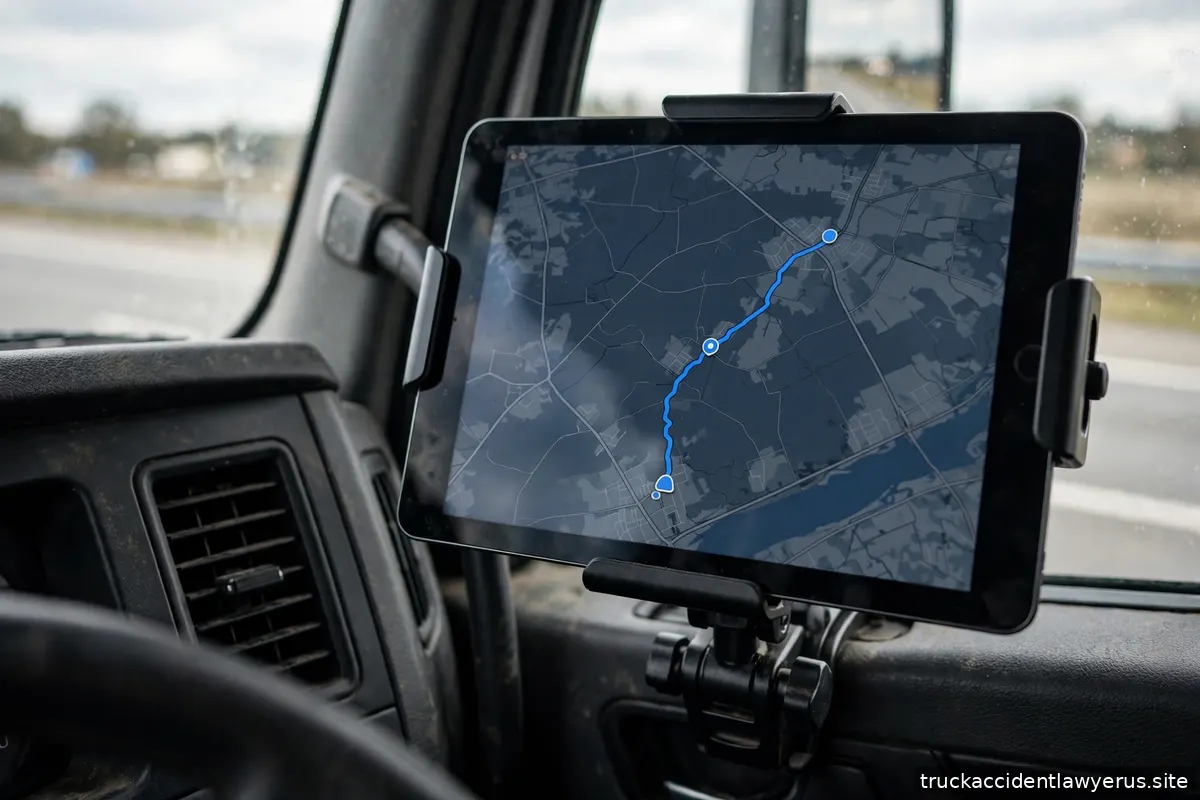
A decade ago, a truck accident investigation meant the police report, witness statements, and the drivers’ accounts. In 2026, it increasingly means data: GPS tracks of the truck’s entire trip, second-by-second speed records, harsh-braking event logs, stability-control activations, and engine diagnostics streamed to the fleet in real time. Telematics — the continuous collection of vehicle operational data — has quietly become one of the most influential factors in how truck accident claims are investigated, negotiated, and settled.
This is a qualitative trends piece: what the technology records, how it is being used in claims today, and what it means practically. No statistics, no predictions about case values — just the changing evidentiary landscape.
What Modern Truck Telematics Records
Telematics platforms combine GPS, engine data, and safety-system inputs into a continuous operational record. A typical system logs location and speed throughout the trip, harsh events (hard braking, rapid acceleration, sharp cornering) flagged automatically, following-distance and collision warnings from forward-looking safety systems, stability-control interventions, hours and duty status integrated with the ELD, engine diagnostics including fault codes, and idle time and fuel data.
The key difference from older “black box” systems is continuity: telematics does not just capture the crash moment but the hours and days around it. Investigators can see the driver’s entire day — rest breaks taken or skipped, speed patterns across terrain, a rising count of harsh-braking events suggesting mounting fatigue — providing behavioral context that a crash snapshot cannot.
How the Data Is Being Used in Claims
On the claimant side, telematics has become a standard discovery target alongside ELD data and dashcam footage. Lawyers request the full telematics record for the trip — not just the crash window — and use it to establish patterns: chronic speeding on the route, ignored collision warnings in the minutes before impact, hours-of-service violations corroborated by GPS movement during logged rest time. A single harsh-braking event means little; a day-long pattern of them tells a story about the driver’s condition.
On the defense side, carriers use their own telematics proactively: to evaluate claims early, to identify cases where the data exonerates their driver (the truck was stopped, the car cut in), and to prepare witnesses with precise timelines. Sophisticated carriers now arrive at settlement discussions with their data already analyzed — which means claimants need their own analysis rather than relying on the carrier’s interpretation. The data is objective; the reading of it is advocacy.

The Effect on Settlement Dynamics
Telematics is compressing the liability phase of claims. When the data clearly shows what happened — the truck’s speed, the driver’s inputs, the warnings issued and ignored — the traditional months-long debate over conflicting accounts shortens dramatically. Cases with clear telematics evidence tend to move faster to damages negotiation, because there is less to argue about regarding fault.
This cuts both ways, and honest assessment requires saying so: telematics sometimes shows the claimant’s own contribution clearly — the sudden lane change in front of the truck, the brake-check, the excessive speed. Objective evidence does not take sides. But for claimants with meritorious cases, the compression effect is generally favorable: less time spent proving the obvious means more focus on full damages development, and carriers facing damning data settle more realistically.
The data is also raising the floor for investigation quality. A lawyer who does not request telematics data in 2026 is leaving the most informative evidence source unexamined — comparable to skipping the police report a generation ago. When evaluating counsel, asking about their approach to electronic truck data is a reasonable proxy for their seriousness about truck cases generally.
Beyond the Crash: Pattern Evidence
Perhaps the most significant trend is the use of telematics as pattern evidence rather than just crash evidence. A driver’s telematics history can show whether dangerous behavior was a one-time lapse or a habit: repeated speeding across weeks, chronic harsh braking suggesting perpetual tailgating, collision warnings routinely ignored. Pattern evidence implicates the carrier too — a company with access to this data that kept dispatching a demonstrably dangerous driver faces direct-negligence questions about supervision.
Fleet-level patterns matter as well: if a carrier’s entire fleet shows elevated harsh-event rates compared to industry norms, that suggests systemic safety-culture problems rather than individual driver issues. Plaintiffs’ lawyers increasingly seek fleet-wide data, and carriers increasingly fight to limit discovery to the individual driver — a battleground that courts are still mapping. The trajectory favors broader disclosure over time, as the data’s relevance becomes harder to dispute.
Privacy, Access, and Legal Limits
Telematics data belongs to the carrier (or the telematics provider under contract terms), and claimants access it through formal legal process — preservation letters followed by discovery requests in litigation. Carriers resist broad requests citing burden, proprietary systems, and driver privacy, and courts balance these against relevance on a case-by-case basis. Driver-facing camera footage raises sharper privacy questions than speed data, and the rules are still developing.
For claimants, the practical points: request preservation early and specifically (name the telematics platform if known, specify the full trip date range, include harsh-event logs and warning histories — not just the crash snapshot). Expect the carrier to have analyzed the data before you see it. And preserve your own digital evidence with equal care — your phone’s location history, your dashcam, your car’s EDR — because the evidentiary standard you demand of the other side applies to you as well. Our black box guide details the full preservation checklist.
Practical Takeaways
First, assume the truck recorded everything and act accordingly: preserve, request preservation formally, and build your case with the data in mind from the start. Second, interpretation matters as much as the data — raw telematics requires analysis to become evidence, which means expert help for serious cases. Third, the data cuts both ways — drive accordingly, because your own behavior may be reconstructed from someone’s telematics as readily as the truck driver’s.
Fourth, patterns beat moments: the most powerful telematics evidence is rarely the crash-second data but the hours of behavior leading up to it. Request broad time ranges, not narrow windows. And finally, recognize that this trend favors the prepared: claimants who move fast on preservation and work with counsel who understand electronic evidence hold a structural advantage over those who treat a 2026 truck crash like a 2006 fender-bender. For the regulatory backdrop to all this data collection, see our hours-of-service explainer and the dashcam trends piece.
Related guides: What Is a Commercial Truck Insurance Policy? Coverage Types Explained, How Truck Accident Lawyer Fees Work: Contingency Fees Explained.
Frequently Asked Questions
Can I see the truck’s telematics data myself?
Not directly — it belongs to the carrier. Your lawyer obtains it through preservation demands and discovery in litigation. What you can do personally is make sure the demand goes out early and covers the full trip, not just the crash moment.
What if the carrier says the telematics data was deleted?
Then the deletion’s circumstances become evidence: when was it deleted, was a preservation duty in place, what do the retention policies say? Courts can sanction spoliation, including instructing juries to assume the lost data was unfavorable. Early written preservation demands are what make these sanctions available.
Does my own car collect telematics too?
Many modern passenger vehicles record event data (speed, braking) and some transmit telematics to the manufacturer. Your car’s EDR data and your phone’s location history are part of the evidentiary picture — preserve them, and discuss with your lawyer before sharing.
Where Telematics Evidence Is Heading
The trajectory points toward more data, not less. Collision-mitigation systems are generating richer event records with each generation — not just that a warning issued, but what the system saw, how the driver responded, and what the outcome was. Driver-monitoring cameras are adding attention-state data: where the driver was looking in the seconds before impact. Vehicle-to-vehicle communication, as it deploys, will create records of what each vehicle broadcast to the others. Each new data stream becomes a new discovery target and a new piece of the reconstruction.
Regulatory developments will shape what must be recorded and retained: event data recorder standards for heavy trucks, potential mandates for specific safety systems, and evolving rules about data ownership and access. The legal framework for obtaining and using this data — what is discoverable, what privacy protections apply, how authenticity is established — is being built case by case right now. Claimants in 2026 sit at an inflection point: the data exists in abundance, but the rules for using it are still being written, which makes knowledgeable counsel more valuable rather than less.
What to Ask Your Lawyer About Electronic Evidence
If you are evaluating counsel for a truck accident case, electronic evidence is a revealing topic. Ask: what data will you seek to preserve, and how quickly? (Expect specific systems named and a days-not-weeks timeline.) How do you analyze telematics and ELD data? (Expect mention of experts or in-house capability, not blank stares.) What pattern evidence will you pursue beyond the crash itself? (The driver’s history, the fleet’s safety data — the broader behavioral picture.) How will you counter the carrier’s interpretation of the data? (Because the carrier analyzes it first and frames it favorably.)
The answers reveal whether the lawyer practices 2026 truck litigation or 2006 car-crash litigation with a truck substituted in. The distinction matters enormously for outcomes: cases built on the full electronic record consistently outperform cases built on paper alone, because objective data persuades adjusters, mediators, and juries in ways that testimony cannot match. In a data-rich case, the best lawyer is the one who knows how to read the data.
This guide is for general information only and is not legal advice. Data-access rules and discovery procedures vary by state — consult a licensed attorney about your situation.