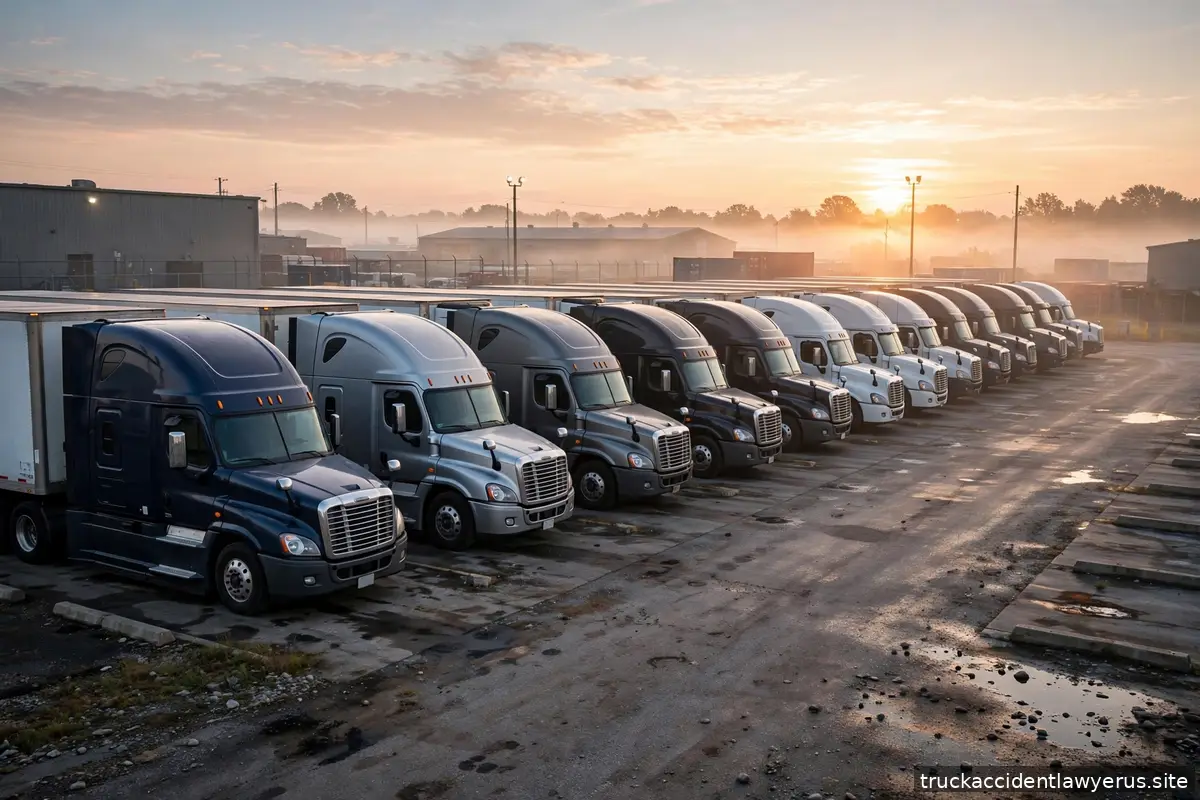
One of the first surprises for people hurt in truck accidents is discovering how different commercial truck insurance is from personal auto insurance. Where a car crash involves one or two policies with modest limits, a truck crash can involve a stack of policies — primary liability, cargo, bobtail, umbrella — with limits in the millions. Understanding this landscape helps you see where compensation can come from and why truck claims are worth pursuing properly.
This guide explains the main types of commercial truck insurance in plain English: what each covers, the federal minimums that apply, and why the structure matters for your claim. General information only — not legal advice, and not an insurance textbook.
Why Truck Insurance Is Built Differently
Commercial trucks cause disproportionate damage when they crash — an 80,000-pound vehicle carries enormous destructive energy. Federal regulators recognized this decades ago and imposed insurance minimums far above personal auto requirements. The result is a layered system designed to make sure money exists to compensate victims of serious crashes.
The key concept is stacking: multiple policies from multiple parties can apply to a single crash. The driver’s policy, the carrier’s policy, the broker’s contingent coverage, and umbrella policies can each contribute. Identifying every applicable policy is one of the most valuable things done early in a truck accident claim — coverage you never find cannot pay you.
Primary Auto Liability: The Main Policy
Every motor carrier operating interstate must carry primary commercial auto liability insurance. Federal law sets the minimum at $750,000 for general freight carriers; carriers hauling hazardous materials face higher minimums ($1 million or $5 million depending on the material). In practice, many carriers carry $1 million in primary liability because shippers and brokers often require it as a condition of doing business.
This policy pays for bodily injury and property damage the carrier’s negligence causes to others — which is exactly what a third-party injury claim taps into. When people talk about “the trucking company’s insurance,” this is usually the policy they mean. The adjuster you deal with most often works for this carrier’s insurer.
The Other Policies in the Stack
Motor truck cargo insurance
Cargo insurance covers the freight being hauled — damage to the goods themselves. It generally does not pay injury claims from a crash, but it matters indirectly: cargo coverage disputes can reveal overloading or improper securement, and the cargo policy’s existence confirms who was responsible for the load. If shifted or spilled cargo contributed to the crash, the cargo insurer and the shipper enter the picture.
Bobtail and non-trucking liability
“Bobtail” means driving the tractor without a trailer attached. A driver’s personal situation gets complicated here: the carrier’s primary policy typically covers the driver only while operating on the carrier’s behalf. Bobtail insurance (or “non-trucking liability”) covers the driver when using the truck for personal reasons — driving home after a delivery, for example. In crashes during these gray-area periods, which policy applies becomes a genuine legal question, and insurers on both sides may point fingers at each other.
Physical damage coverage
This covers damage to the truck itself — the carrier’s own asset. It does not pay your claim, but the existence and handling of the physical-damage claim can produce useful evidence: repair records documenting the force of impact, for instance.
Umbrella and excess policies
Large carriers and fleets often carry umbrella or excess liability policies that kick in when the primary policy’s limits are exhausted — sometimes adding $5 million, $10 million, or more in coverage. These policies are the reason catastrophic-injury truck cases can result in meaningful compensation. They are also the reason carriers fight hard: the more coverage at stake, the more aggressively insurers defend.
Owner-Operators: A Special Case
Many truck drivers are independent owner-operators leased to a carrier rather than employees. Their insurance situation is layered by design: the owner-operator typically carries their own bobtail/non-trucking liability policy, while the carrier’s primary policy covers them when operating under the carrier’s authority (“under dispatch”). Whether a crash happened “under dispatch” is frequently disputed — the answer determines which insurer pays, and both insurers have incentive to say the other one should.
This is one area where the truck’s electronic logging device and dispatch records become decisive: they show whether the driver was on a carrier-assigned trip or running a personal errand. If you were hit by an owner-operator, expect this question to arise, and understand that a thorough police report noting the driver’s employment and dispatch status helps enormously.
Federal Minimums and How to Verify Coverage
The Federal Motor Carrier Safety Administration requires interstate carriers to maintain the minimum liability coverage described above and to file proof of insurance with the agency. Carriers operating solely within one state follow that state’s rules, which vary. You can look up a carrier’s insurance filings through FMCSA’s public systems using the USDOT number from the truck’s door — a practical use of the identifiers we tell you to photograph at the scene.
Minimums are floors, not ceilings, and they are also somewhat dated — the $750,000 general-freight minimum has not changed in decades despite rising medical costs. Many safety advocates consider it inadequate for catastrophic crashes, which is one reason identifying umbrella coverage and additional liable parties matters so much in serious cases. For background on the agency that sets these rules, the FMCSA’s official site publishes carrier safety and insurance information.
Why All of This Matters for Your Claim
Three practical takeaways. First, truck crashes usually involve far more available coverage than car crashes — do not assume a serious injury claim will hit a policy ceiling the way it might with a minimally insured driver. Second, the complexity means claims take longer and involve more negotiation; patience and thorough documentation pay off. Third, because multiple insurers may share the bill, they spend considerable energy arguing about whose policy applies — a dispute you want resolved in your favor, ideally with professional help.
If the coverage picture looks complicated — an owner-operator, a brokered load, hazmat, a disputed dispatch status — that complexity is itself a reason to consult a lawyer early. Untangling insurance stacks is core truck-accident-lawyer work, and it is difficult to do effectively on your own. Our guide to whether you need a truck accident lawyer can help you decide.
Related guides: Truck Weight Limits and Why Overloading Causes Crashes, 2026: Virtual Consultations Are Now the Norm: What to Expect.
Frequently Asked Questions
What if my damages exceed the truck’s policy limits?
Then the search expands: umbrella policies, additional liable parties (broker, shipper, maintenance company), and your own underinsured-motorist coverage. This layering is exactly why identifying every party and policy early is so important.
What if the truck was uninsured or the carrier let coverage lapse?
Your own uninsured/underinsured motorist coverage becomes critical — check your policy limits now, before you need them. The carrier and driver remain personally liable, but collecting from an uninsured company is difficult, which is why UM/UIM coverage is some of the most valuable insurance you can buy.
Can I see the actual insurance policy?
Insurers rarely volunteer the full policy, but in litigation the policy is discoverable. Your lawyer can also verify filed coverage minimums through FMCSA records using the carrier’s DOT number.
How to Find Out What Coverage Actually Exists
Insurers do not publish their policy limits to claimants voluntarily, but coverage can be discovered through several channels. Start with the police report, which usually lists the carrier’s insurance company. The truck’s USDOT number lets you look up the carrier’s filed insurance in FMCSA’s public records — this confirms the existence of at least the federal minimum coverage and identifies the insurer of record.
Your lawyer has stronger tools: formal discovery in litigation compels production of the actual policies, including umbrella and excess layers the carrier would prefer you never knew about. Even before litigation, a well-crafted demand letter from an attorney often prompts voluntary disclosure, because insurers know the information will surface anyway. If you are handling a smaller claim yourself, simply asking the adjuster in writing to confirm all applicable policies and limits is reasonable — the answer (or refusal) tells you something either way.
One more source people overlook: the freight broker. If a broker arranged the load, the broker may carry contingent auto liability coverage that applies when the carrier’s policy is insufficient. Identifying the broker — from shipping documents, the bill of lading, or dispatch records — opens another potential avenue that adjusters will not volunteer.
State vs. Interstate: Why the Distinction Matters
Federal insurance minimums apply to carriers operating across state lines (interstate commerce). A truck that never leaves its home state (intrastate) follows that state’s insurance rules instead, which are sometimes lower — some states require far less than the federal $750,000 minimum for certain intrastate operations. The distinction matters because it sets the floor of available coverage.
Determining which regime applies is not always obvious: a truck plated in one state might be running an interstate load, or an interstate carrier might be doing a local intrastate run. The bill of lading and dispatch records usually settle the question. In practice, many intrastate carriers carry higher limits than their state requires because shippers demand it — so the state minimum is a floor for the investigation, not the final answer. Either way, the principle from the rest of this guide holds: verify coverage through records, do not assume it from minimums.
Can more than one policy pay for the same crash?
Yes — and this is one of the most important differences from car accidents. The carrier’s primary liability policy typically pays first, and umbrella or excess policies cover amounts above the primary limits. If a broker’s contingent coverage or the driver’s own policy also applies, those can contribute as well. The policies coordinate rather than duplicate: you cannot collect the same dollar of damages twice, but multiple policies together can cover catastrophic losses that would exhaust any single policy. Identifying the full stack early is why serious truck claims involve thorough investigation of every party’s coverage.
This guide is for general information only and is not legal advice. Insurance structures vary by carrier and state — consult a licensed attorney about your specific claim.